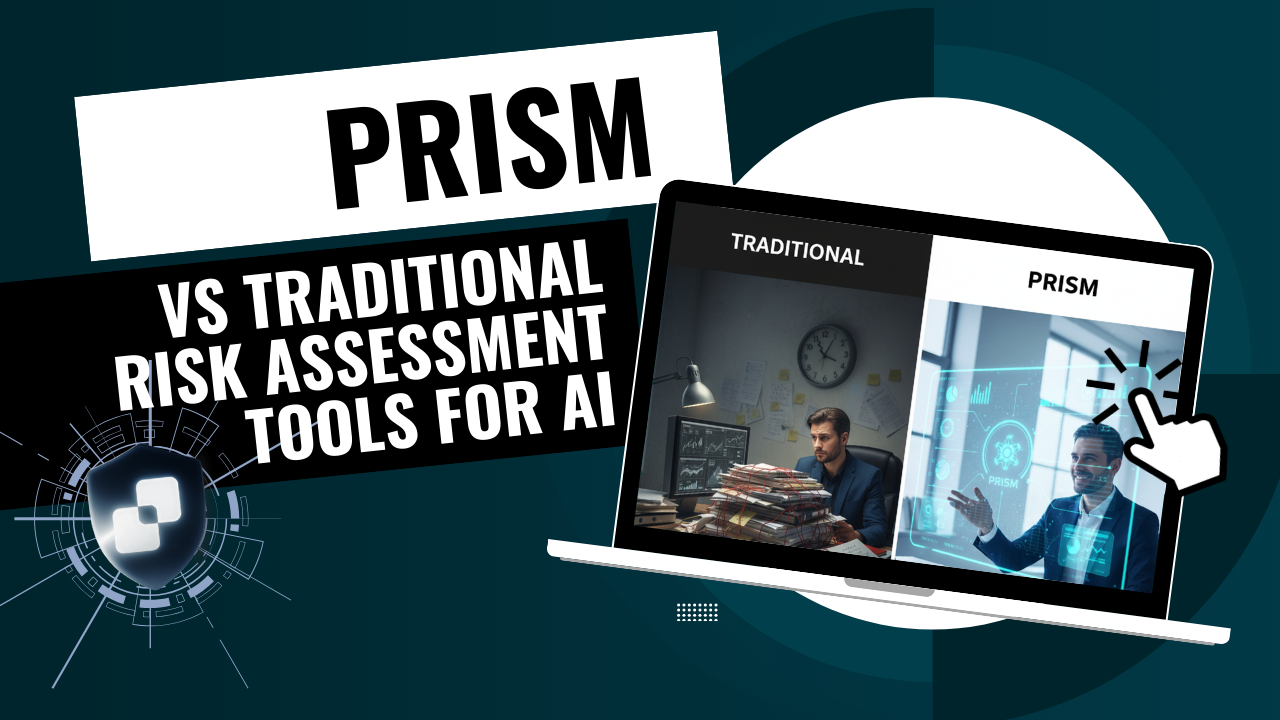
PRISM vs Traditional Risk Assessment Tools for AI
Table of Contents
As organizations adopt AI at scale, risk assessment has become a critical part of ensuring safety, compliance, and trustworthiness. Traditional risk assessment tools — spreadsheets, static frameworks, and manual audits — have been used for decades. But when it comes to AI, with its complexity and constant evolution, these tools often fall short.
PRISM by Block Convey represents a new generation of AI governance solutions, offering automation, real-time monitoring, and compliance alignment with global standards such as ISO 42001, NIST AI RMF, GDPR, and the EU AI Act. This guide compares PRISM with traditional AI risk assessment methods, helping you understand which approach is right for your business.
Traditional AI Risk Assessment Tools: The Old Way
Traditional risk assessment tools rely heavily on manual documentation, human judgment, and periodic reviews. Common methods include:
- Spreadsheets & Checklists: Teams track risks manually, updating them only during reviews or audits.
- Static Risk Frameworks: One-time assessments that don't adapt as AI systems evolve.
- Consultant-Led Audits: Dependence on external experts who provide a snapshot, not continuous monitoring.
Limitations of Traditional Tools
- Time-Intensive: Preparing risk documentation takes weeks or months.
- Error-Prone: Human oversight leads to missed risks and inconsistent reporting.
- Reactive, Not Proactive: Risks are often identified only after deployment or when an incident occurs.
- Lack of Scalability: As AI projects grow, managing risks across multiple models becomes overwhelming.
PRISM: The Modern AI Risk Assessment Solution
Unlike traditional methods, PRISM is designed to handle the dynamic and complex nature of AI systems. It provides an integrated platform for risk assessment, governance, and compliance documentation.
Key Features of PRISM
- 1Real-Time Monitoring: Tracks AI models continuously, flagging new risks as they arise.
- 2Automated Documentation: Generates compliance-ready reports aligned with standards like ISO 42001 and NIST AI RMF.
- 3Benchmarking & Scoring: Compares your AI system against industry best practices.
- 4Collaboration Tools: Enables cross-functional teams to manage risks on one centralized platform.
- 5Audit-Ready Templates: Provides standardized risk assessment formats for regulatory reviews and investor due diligence.
Why PRISM Is Different
Instead of offering just a snapshot of risk (like traditional audits), PRISM provides a continuous, proactive, and adaptive approach, ensuring your AI systems remain trustworthy over time.
PRISM vs Traditional AI Risk Assessment: Side-by-Side Comparison
| Feature | Traditional Tools | PRISM by Block Convey |
|---|---|---|
| Risk Assessment Approach | Manual, checklist-based | Automated, AI-driven |
| Documentation | Static reports, updated occasionally | Dynamic, real-time compliance documentation |
| Regulatory Alignment | Partial, inconsistent | Fully aligned with ISO 42001, NIST AI RMF, GDPR, EU AI Act |
| Scalability | Limited – hard to manage multiple projects | Highly scalable for startups & enterprises |
| Audit Readiness | Requires heavy preparation | Instant audit-ready reports |
| Cost & Efficiency | High cost due to labor & consultants | Cost-efficient automation with faster reporting |
| Adaptability | Cannot keep up with evolving AI systems | Designed for continuous monitoring & updates |
| Collaboration | Fragmented across teams | Centralized compliance hub for all stakeholders |
Benefits of Choosing PRISM Over Traditional Tools
1. Time Savings
Cut documentation and audit prep from months to days.
2. Proactive Risk Management
Identify and mitigate risks before they cause damage.
3. Regulatory Confidence
Stay ahead of evolving compliance standards without constant manual work.
4. Investor & Vendor Trust
Provide transparent, audit-ready risk assessments to stakeholders.
5. Scalable Governance
Easily manage multiple AI projects across teams and geographies.
PRISM Works Best When:
- You're scaling AI projects across teams or markets.
- Regulatory compliance is essential (ISO 42001, NIST, GDPR, EU AI Act).
- You need continuous monitoring, not just one-time audits.
- You want to reduce costs without compromising governance.
FAQs
Why are traditional risk assessment tools insufficient for AI?
Because AI systems evolve continuously, static frameworks cannot keep up with emerging risks.
What makes PRISM different?
PRISM provides real-time monitoring, automated documentation, and alignment with global AI compliance standards.
Can PRISM work alongside traditional tools?
Yes. Many organizations start with traditional checklists but integrate PRISM for scalability and automation.
Is PRISM suitable for startups?
Absolutely. PRISM helps startups build investor trust by providing compliance-ready documentation.
Which compliance standards does PRISM support?
ISO 42001, NIST AI RMF, GDPR, HIPAA, and the EU AI Act.
Conclusion: The Future Belongs to Automated AI Risk Assessment
Traditional tools laid the foundation for risk management, but they struggle with the dynamic nature of AI systems.
PRISM represents the next evolution in AI risk assessment: automated, scalable, and compliance-focused. By moving beyond manual checklists and static frameworks, organizations can build AI systems that are not only compliant but also trustworthy, transparent, and resilient.
For businesses looking to future-proof their AI governance strategy, PRISM is the smarter choice.
Ready to Upgrade Your AI Risk Assessment?
Discover how PRISM can help your organization build trust, ensure compliance, and drive AI success with modern risk assessment tools.
Learn More About PRISM