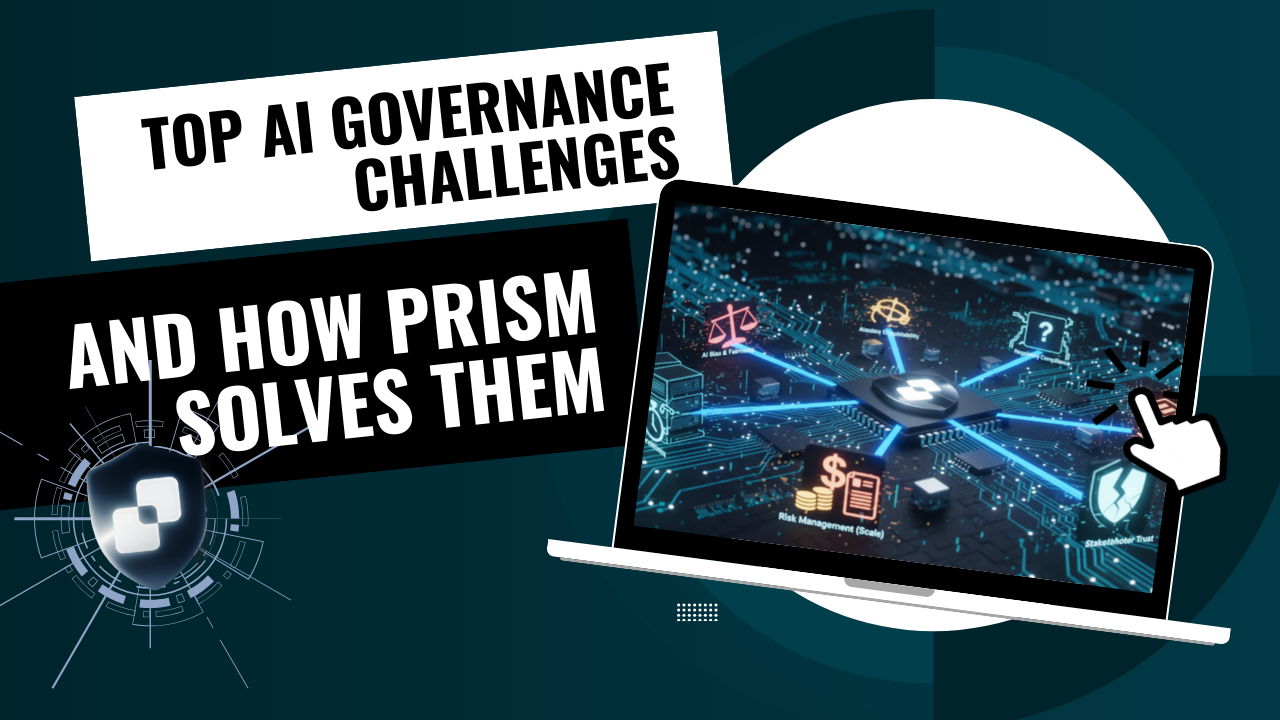
Top AI Governance Challenges and How PRISM Solves Them
Table of Contents
Introduction
AI is no longer a futuristic concept—it's powering decisions in healthcare, finance, retail, and beyond. But with its rapid adoption comes growing concern: How do we ensure AI is safe, ethical, transparent, and compliant? That's where AI governance comes in.
While organizations understand the need for governance, many struggle with practical challenges like bias, evolving regulations, lack of explainability, and scalability issues. Without the right tools, governance can feel like a never-ending uphill battle.
This is where PRISM by Block Convey offers a breakthrough. PRISM is built to simplify AI governance with automation, compliance frameworks, and continuous monitoring, helping businesses overcome these challenges head-on.
Challenge 1: AI Bias and Fairness
One of the biggest governance concerns is bias—AI models often reflect or even amplify societal inequalities. This can result in unfair hiring systems, biased credit scoring, or discriminatory healthcare outcomes.
How PRISM Solves It
PRISM helps organizations detect, measure, and mitigate bias by continuously monitoring data inputs, model behavior, and outputs. It provides bias reports that highlight risks and recommend corrective actions, ensuring AI systems stay fair and ethical.
Challenge 2: Regulatory Compliance (ISO 42001, GDPR, EU AI Act)
Global regulations for AI are evolving rapidly. From ISO 42001 to the EU AI Act, organizations must prove they're managing AI responsibly. The challenge? Compliance demands are complex, time-consuming, and vary across regions.
How PRISM Solves It
PRISM automates compliance documentation, aligning with key frameworks such as ISO 42001, NIST AI RMF, GDPR, HIPAA, and EU AI Act. Instead of spending weeks preparing reports, businesses can generate audit-ready documentation instantly.
Challenge 3: Lack of Explainability
AI often functions as a "black box," making decisions without clear explanations. For high-stakes use cases like healthcare, law, and finance, this lack of explainability erodes trust.
How PRISM Solves It
PRISM integrates explainability features that clarify how AI systems reach decisions. By making AI outputs transparent and interpretable, organizations can build trust with regulators, investors, and end-users.
Challenge 4: Risk Management Across Multiple AI Systems
As organizations scale, managing risk across dozens of AI models becomes overwhelming. Traditional tools like spreadsheets or one-time audits can't keep up with the dynamic nature of AI risks.
How PRISM Solves It
PRISM provides continuous, centralized monitoring across all AI systems. It benchmarks performance, highlights anomalies, and ensures governance policies are consistently applied, even as the AI portfolio grows.
Challenge 5: Audit Readiness and Investor Confidence
Investors, partners, and vendors increasingly demand proof of responsible AI governance. But creating detailed, audit-ready reports manually takes enormous time and resources.
How PRISM Solves It
With PRISM, organizations can instantly generate audit-ready, standardized reports. These reports not only satisfy compliance requirements but also boost investor confidence by demonstrating proactive governance.
Challenge 6: Cost and Resource Constraints
Governance often feels like a luxury for startups or mid-sized companies. Hiring compliance teams and consultants can be prohibitively expensive.
How PRISM Solves It
PRISM makes governance cost-efficient by replacing manual processes with automation. Startups and enterprises alike can achieve compliance at a fraction of the cost of traditional methods.
Challenge 7: Building Stakeholder Trust
Ultimately, governance is about trust—from customers, regulators, and society at large. Without strong governance, AI adoption risks slowing down due to skepticism and fear.
How PRISM Solves It
PRISM provides transparent governance dashboards and reports, enabling businesses to demonstrate responsibility, build credibility, and earn stakeholder trust.
PRISM vs Traditional Governance Approaches
| Challenge | Traditional Approach | PRISM Solution |
|---|---|---|
| AI Bias | Periodic manual checks | Continuous bias detection & reporting |
| Compliance | Consultant-heavy audits | Automated ISO, NIST, GDPR alignment |
| Explainability | Limited transparency | Built-in explainability reports |
| Risk Management | Fragmented, manual | Centralized, real-time monitoring |
| Audit Readiness | Weeks of prep work | Instant audit-ready reports |
| Costs | High compliance spend | Cost-efficient automation |
| Trust | Minimal proof | Transparent dashboards & reporting |
Conclusion: Solving Governance Challenges with PRISM
AI governance is essential—but it doesn't have to be overwhelming. From bias detection and regulatory compliance to explainability and investor readiness, PRISM streamlines every part of governance.
By adopting PRISM, businesses not only meet compliance but also gain a strategic advantage: they build AI systems that are trustworthy, transparent, and future-ready.
FAQs: AI Governance Challenges
1. What is the biggest challenge in AI governance?
Bias and regulatory compliance are the most common challenges, especially for high-risk AI systems.
2. How does PRISM handle global regulations like ISO 42001 and GDPR?
PRISM automates documentation and aligns with multiple standards, saving organizations significant time and effort.
3. Is PRISM suitable for startups?
Yes, PRISM is designed to help startups manage compliance cost-effectively while building investor trust.
4. Can PRISM improve AI explainability?
Yes, PRISM offers explainability features that make AI outputs transparent and interpretable.
5. Why is PRISM better than traditional tools?
Traditional governance is manual and reactive, while PRISM is automated, proactive, and scalable.
Ready to Overcome AI Governance Challenges?
Discover how PRISM can help your organization solve bias, compliance, and trust challenges with automation and real-time monitoring.
Explore PRISM Solutions